
7. The day the whale sharks came … then the hammerheads!

Onto Darwin island, arguably one of the most famous and bucket list dive locations in the world as part of the Galápagos archipelago. And it did not disappoint. We did three morning dives there and the whale sharks came for every, single one! Some were quite small babies (around 8m) and some were mega giants (12m and larger). For the first couple of dives, they tended to sweep in over our heads and cruise over above. You knew they were there because you were plunged into shadow as the behemoths blocked the sun! On our third dive, they were a bit further out into the blue which, fortunately, our guides could somehow spot. The guide would shake his noise maker, point and start swimming and we’d need to be on our game, alert and take off, at speed, swimming hard after them. Each time, I knew what it would be that we were seeking but I couldn’t ever see them until suddenly, they’d materialise. There’s a clip from a video in the gallery of one of the men, who’s about 6ft tall, swimming towards one of the big whale shark’s tale so you can see, for scale, their massive size!
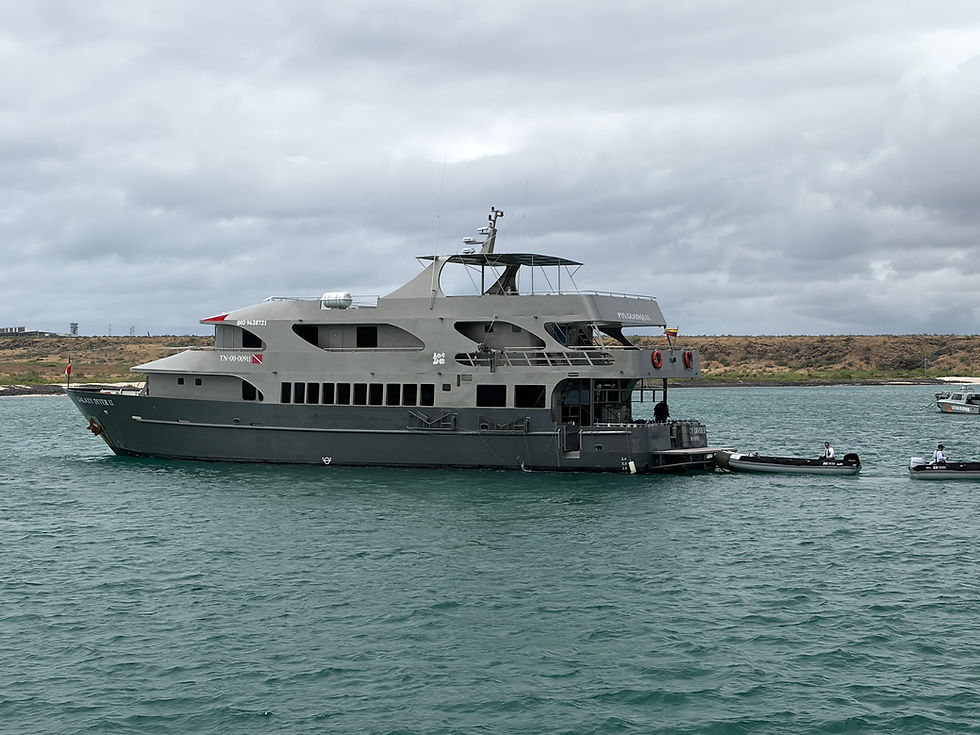
We went back and back again on Darwin to try for as many encounters as we could get. Each time, that means a full gearing up, hauling on rash guard layer, 7mm wet suit, socks, boots, gloves and hood. Once ready, gear on your back, you stagger over to the edge of the big boat where several boat boys stand - two on the big boat and two on the zodiac (inflatable rib speed boat) and the skill was to transfer from one to the other without incident. The sea is pretty rough & the swell can be 4-5m so they wait for a break, each grab an arm and count to tell you when to step across. It’ll then be a 10 minute rib ride out to the dive site, in crashing swell and sea. On the way out, we all perch along the sides of the rib, holding on, as we bump across the water. It’s a bit of an endurance event as it’s kind of a deep squat position fighting to stay both upright and actually in the boat. Once we arrive, it’s a backroll off the boat on the count of 3, all 9 of us at the same time to try and avoid any tank-to-the-head injuries. A ‘negative’ entry is required here so the idea is jackets are empty of air, you roll in and descend straight down to avoid any time getting thrown about on the surface. Once underwater, the current can be pretty full on so you kick down to a rock, get a hold and start dragging yourself over the rocks until you get to the place to wait. Sometimes we wait for 30 minutes watching the hammerheads cruise by or sometimes, a whale shark comes quickly and we take off after it. Either way, you earn the several course serving of whatever meal comes directly after each dive! And it’s all worth it for the whale sharks!
Our final day in the north was two dives at Darwin then, after a fairly bumpy sail, we returned to Wolf for two afternoon dives. At Darwin, the whale sharks were obviously on a break but we saw lots of other nice life with turtles and the garden eels just poking their heads out the sand. At Wolf, this time, the hammerhead sharks really came out to play … in their hundreds! I was busily admiring a little group of lovely eagle rays when there seemed to be quite the kerfuffle going on around me and when I looked up, I realised why. Hammerhead after hammerhead were coasting by. They came round, over and under us and and stayed around for ages. As we neared the end of the dive, we swam out to start shallowing up and get to where the dingy could pick us up and suddenly, what I will describe as a wall of hammerheads were in front of us, all cruising by. We ran down our air and our depth clocks and hung with them for as long as we could.
Our final dive was meant to be back somewhere shallow but the plan was changed and we went back to the same site - Land Slide - and hung with the hammers again. The current was pretty intense so you help on, found a rock to hide behind and grip on to and settled in for the show. At one point, I wondered what was poking at me when I looked down and realised I was sharing the hole I’d found with lobster. Fortunately we seemed quite friendly! In amongst the hammers, there were also the odd Galápagos sharks - which are the ones with the ‘normal’ heads & who seemed quite curious and would come quite close!
On our last full day of diving, after another quite rocking overnight sail - which at times was so ‘rocking’ that all the bedroom furniture of two beds and two bedside tables sailed across the floor and then crashed back the other way with some of the biggest swell - we awoke at Fernandino island. The first dive, we hoped for mola mola (sunfish) but didn’t see them. We saw a little bull head shark, a ray and some nice fish and also got our first dose of ‘colder’ water. From the 28° we’d had so far, we were plunged into 22°C and absolutely bastard bloody cold water none of us were quite prepared for. Mostly we were tightly wrapped in layers of insulation. And then there was Mike, the dive boat captain from New Zealand, who runs a great white cage shark dive centre on the southern most tip of NZ in 12°C water, who was still in his 3mm shortie!!
Our next dive was really more of a snorkel while wearing full dive gear and many layers of neoprene as we stuck along the shallows of the coast line looking for the marine iguanas. They swim along the surface, dive down and munch on all the delicious sea weed. Holding on to rocks while trying not to disturb the iguana at the same time as getting slightly battered by surge, waves and shallow rocks wasn’t hugely fun - but the iguana made it worth it! As did the lovely octopus who came to see the ridiculous humans rolling about in the surf while wearing metal tanks!
Third dive of the day was off the eastern coast of Isabella island where we did, finally, get to see the mola mola! Oh what a treat. They are the weirdest looking fish (the largest boney fish in the world - basically massive moon shaped circular discs with two huge fins, one on top and one below! They are between 2.5-4m in height and weigh in at around 800kg. Fortunately, we saw them early in the dive - when it was down to about 21°C and I was thankful for my layers of neoprene - totalling 11mm on my top half, 7mm on my legs, thick socks, boots, gloves and a thick hood! A few minutes after we’d watched them, a meg current blew through just as we were moving to travel along the wall. It was against us and we had to get past it to avoid being washed off the point and out to sea so all ended up gripped onto rocks and dragging ourselves through a little protected channel. Holding on with both hands, dragging ourselves along - it took all the strength I had and full kicking. Makes you realise why the unpredictable currents necessitate the additional safety alarms and GPS. We all made it through successfully and have another story to add to our trip! Immediately after hauling everything back into the rib, we went for a little ride - still in 11mm of neoprene and by now in the full sun!! - to bob along the foot of the cliffs and into a little bay where we saw a little penguin, a tiny baby sea lion, some cool rock and lava formations and also the flightless cormorants resting on the stones!
Final part of the day (prior to a minimum of three courses meal which will be next, just before bedtime) was being allowed into the bridge with the Captain to watch as we crossed the equator, and the instrument panels counted down to 00000 as we went across.he was terrible serious during the event but then very amenable to a selfie after. Quite the momentous occasion. Final day tomorrow has one last dive & a trip into the highlands to visits the giant tortoises again. On Wednesday, I’ll disembark in the morning and make way back to Puerto Ayora to meet back up with Dad, see all the paintings I know he’s been busy doing this week & stock up on all my whale shark and hammer head related souvenirs before we head back to mainland Equador.


Comments