
3. The tour: Off to Isabella, with a hurricane of boobies!

On the first day of our tour, we travelled as far as ‘just down the hill’ dragging my many bags of luggage to a hotel nearby our little apartment where we met up with our group and officially began our tour. Our first ‘trip’ was a walk into town to collect snorkelling equipment that we’d have for the week. We then had a bit of time to explore the town (where we’d already spent 5 days) so Dad and I went for ice cream for lunch! Our first actual excursion was piling onto the minibus and heading a bit further round the island to Loberia Beach where we walked along a different part of the coast spotting the marine iguanas and ubiquitous sea lions, and then we could snorkel in the bay. Our guide (Lorenzo) explained that we’d all go as a group he’d lead as we snorkelled out round the bay. I had to begin my introduction to the group by explaining that I couldn’t do that as I’m a massive baby about being out of my depth or too far from shore on the surface (it’s not the same as diving, no matter what anyone says) so I’d flop about in the shallows a bit while the grown ups went proper snorkelling. In the evening we all went for dinner together (organised by Lorenzo) and fortunately went to a nice pier side restaurant that we’d looked at and discussed going to a few times but hadn’t yet visited.
Our group is 15 people, one family of 4 with older teen children, one British man who’s got extended time off work so is on his own travelling South America while his wife stayed at home and then the rest are couples in their 50s and 60s I think (possibly older) who are all from Australia or NZ. So far everyone seems quite nice …. One of the Aussies looks like a slightly smaller but otherwise exact replica version of Jim Royle (from The Royle Family TV show, Mum) and one of the teen daughters refuses to do any of the outings and instead sits playing games on her phone with headphones in while her parents pander to her. But I haven’t experienced enough to pass further comment …
Day two started bright and early with a 7.45 start at the dock ready for our boat trip, where we then waited 35 minutes to get going! We headed first to a beach with some mangroves and where we could go snorkelling. Dad and the others went in, overseen but a couple of huge pelicans who seemed to take it upon themselves to supervise from their vantage points in the trees and floating on the water to keep everyone safe. Just as well as I’m not convinced the guide was fully alert and aware of everyone’s positions.
From there, we headed back (for me!) to Kicker Rock, where we would be snorkelers for the day. A snorkeler is a land-person who likes to hang about on the sea looking down into it. They put tiny plastic tubes in their mouth and breath directly just from the air. The water was still fairly murky but I braved the almost certain death by sea monster from below when swimming out of your depth and participated in the ‘water activities’ of swimming round the foot of the rock watching fish, some sea turtles and a sea lion streak by. After two snorkelling sessions (I participated in one of them as I was interested not mental) and some time on the boat, we started heading back to the main island. I’d all but given up hope of the promised lunch materialising. I shouldn’t have worried though as suddenly, a large folding table was carried out from the tiny cabin, unfolded and erected taking up the whole floor space of the boat, a floral table cloth was spread over it and plates of chicken, beans rice and salad were handed round!
After a quick shower, change (& power nap!) we headed back out to walk to the Interpretation Centre to read about Galapagos - the formation, inhabitations and ongoing struggles caused by humans and tourism. We walked up to a viewpoint overlooking the headland then all the way back down just in time to catch sunset on the beach. A final dinner on San Cristobal Island was pizza for us, while watching and listening to the honk and calls of the resident sea lions. I only once had to leap out of my chair and dash to safety away from a pair of rampaging male sealions. One of the noisy males had lumbered all the way up the pier and round on the pavement along by the harbour and proceeded to chase another male at quite some pace down the pavement. Fortunately, I didn’t need to move to panic level of ‘screaming really loudly’ as the big beasts crashed back through a wooden gate, broke it and made their way back onto the beach to continue their disagreement! The largest males are the dominant ‘bulls’. Various other large males seem to challenge sometimes for dominance and they can get quite aggressive with each other when trying to preserve their place in the hierarchy they’ve created. The females tend to entirely ignore them and sleep and play while the males continue their parade of noises and size around the place, impressing, at best, maybe each other. The patriarchy would love it.
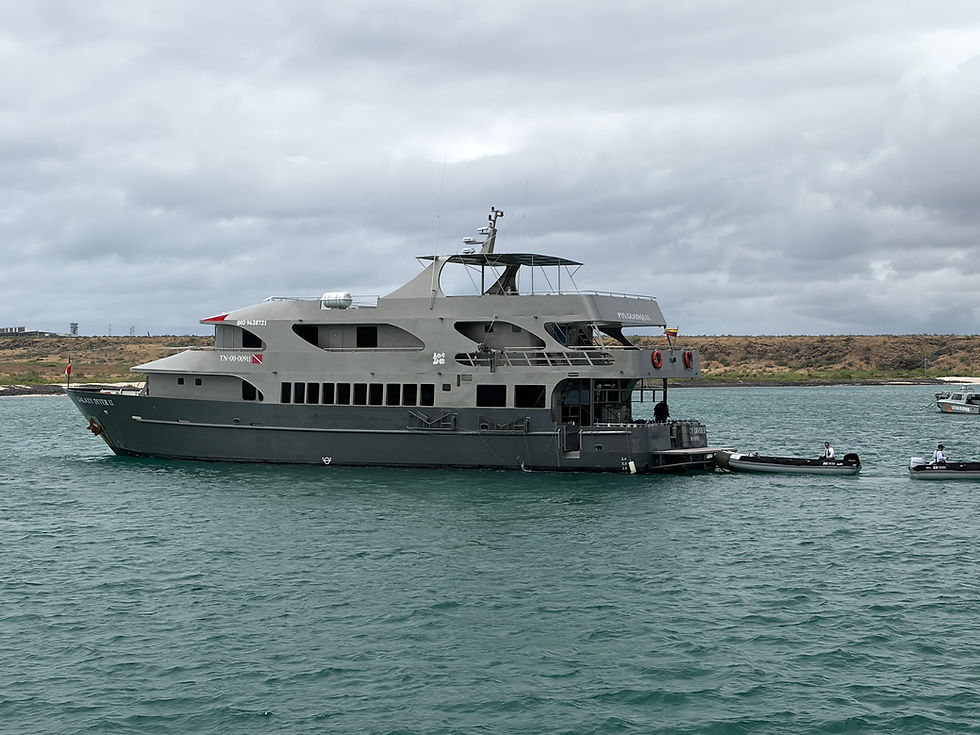
Day 3 of the tour was the first island hop, which meant packing up everything and loading up a car with our big bags (fortunately I wasn’t expected to carry my own luggage any distance!). There was a lot of small parts involved in the moving; we loaded big bags onto a truck then collected them at the pier, rolled them down the pier where everything had to be searched by the stone police before it was loaded onto a water taxi which eventually got us to the big boat! They are so concerned about plants, animals or seeds being moved between islands and the risk of contamination and introducing different species or variations that would risk fragile island ecosystems. Soles of all trainers had to scrubbed and bags checked for stones or plants. If one were to attempt to collect and liberate any shells, for example, one would have to do it with extreme levels of concealment.
We journeyed by (mostly) enclosed speed boat over to the tiny island of Floreana where we walked / snorkelled on the beach and had dinner in one of the few restaurants available. The island is home to only around 150 human inhabitants and thousands of massive marine iguanas! There are also a number of sea lions making themselves at home wherever they please although far less than on San Cristobal. We also saw the postcard barrel - a historical relic that remains in use. You can write a postcard and drop it into the box. Each visitor then checks the box and if they live anywhere near the address, they take the card back home with them and (ideally) hand deliver it. We didn’t drop any postcards in but we did look through and few people took some for addresses they lived near. Unfortunately there weren’t any for Portsmouth or the surrounding areas!
From Floreana, we headed back via water taxi to the speed boat for another 2 hours onto Isla Isabella, our home for the next 3 nights and where the activities begin in earnest at 7.15am.
First call for Isabella was kayaking round the bay. The idea was that we’d be spotting the wildlife and taking in the sites. Mostly we tried to avoid playing bumper kayaks with anyone else and discussing which way up the oars go and how to turn corners. We did manage to successfully navigate our way across the bay, following our group leader, along the rocks and mangroves and back to the base, all without capsizing or going too far off course.
From kayaking, we went immediately to a little boat trip, to look at the same bay and rocks but on a much steadier, and dare I say, more capably captained, vessel and so we could take photos - just in time for a few penguins to arrive and sun themselves on the rocks, along with more boobies and a great heron with her chicks. We then docked the boat and walked around a little island formed almost entirely of lava field and where the baby iguanas are born and hang out. They stay in groups for survival while they’re so small. I suppose if you’re not the smallest or slowest of the group, you should be ok! Final stop of the morning was donning our teeny tiny snorkel fins and leaping (more of an undignified flop) over the side of the boat to snorkel with the turtles, parrot fish, sea cucumbers and white tipped reef sharks!
At lunch, we went for a walk to the beach and discovered an absolute mass of sea birds - what I will describe as a hurricane of boobies accompanied by about as many pelicans - well over a hundred of them all swirling and diving into the sea off the beach.
As if that wasn’t enough in a day, for our afternoon, we visited a tortoise breeding centre. When the Galapagos was originally discovered and eventually settled, the early expeditions noticed the similarities between the tortoise shells and horse saddles. At one time, the islands were referred to as ‘The Islands of the Saddlebacks’, or for short ‘Galapago’, the Spanish word for a type of horse saddle. Once they’d named the island especially for them, all the brainless humans proceeded to eat their way through the majority of the giant tortoise population decimating the 300,000 thousand (other sources estimate the original tortoise population at closer to 1 millions!) tortoises by killing 90% of them. They only reduced their consumption when conservationists raised the alarm in the 1950s, with national park status being granted by Ecuador in 1959.
Rats and other invasive species did further damage by either eating the vegetation the tortoises survived on (goats and mules) or by crushing or eating the tortoise eggs (cows, rats and ants!). Now, it is unlikely that any wild tortoise eggs will survive to full grown tortoises due to the extensive threat so human intervention of the good kind is required. All of the larger islands here have tortoise breeding ventures and programmes with the eventual aim of repopulating the island to its original giant tortoise numbers. The breeding centres breed adults, collect the eggs then rear the babies, first in fully enclosed shelters (to protect from rats) then in open enclosures. They stay at the centres until they’re big enough to no longer be threatened and are then released into the wild. Full grown tortoises could be alive in 150 years and far outlive the humans currently rearing them. There was a lovely illustration of the two life spans included at the breeding centre to really make the point!
Our final stop on the way back to town was at a brackish lake just near our hotel where a little flock of flamingoes were resting, feeding and posing for some lovely photos with their reflections. Tomorrow the plan is to wake up ludicrously early and spend 6 hours walking up (and back down) a volcano. There are no cafes, tea stops or toilets anywhere along the route - but there is likely low cloud and a fairly constant drizzle near the caldera.. It seems highly unlikely to me that there will be any joy but lots of hill walking up that volcano. If that’s the sort of trip I enjoyed,I’d wait for a rainy day at home and scale Buster Mountain! I may give it a miss. Not unlike the teenage daughter, who is actually 19 yrs old, with the family in our group. She has so far refused to do every single trip and has stayed in her room playing on her phone. I wish the alpha male chap from NZ would consider doing the same. He had to be at the front of the kayaking group, first to dive down (and scare away) anything we saw while snorkelling and, I would imagine, will be running up the volcano tomorrow! Nob.


isn't nob spelt with a k??!!
I have every sympathy with hating the early start - especially to climb mountains.
Why did they bring a 19 yr old who could have safely stayed at home - what a waste of money!
love all of the photos and stories. Very pleased we don't have real stone police in Europe! I'd be in prison for years. So pleased its all going well. XXX